Description
This case study is an independent architecture design exercise developed to demonstrate cloud-native platform engineering methodology for enterprise microservices delivery. It was not associated with a production deployment. The scenario is based on the platform engineering and operational governance requirements typical of organisations modernising toward Kubernetes-based microservices delivery across multi-team enterprise environments.
This case study is an independent architecture design exercise developed to demonstrate cloud-native platform engineering methodology for enterprise microservices delivery. It was not associated with a production deployment. The scenario is based on the platform engineering and operational governance requirements typical of organisations modernising toward Kubernetes-based microservices delivery across multi-team enterprise environments.
Key Focus Areas:
Kubernetes Platform Engineering
GitOps & CI/CD Automation
Cloud-Native Application Delivery
Observability & FinOps Governance
AKS Security Architecture
Namespace-Based Multi-Tenancy
Executive Summary
Architected a cloud-native application delivery platform on Microsoft Azure enabling standardised microservices deployment, GitOps-driven operations, automated CI/CD workflows, dynamic workload scaling, and centralised operational governance across multi-team enterprise environments.
The platform combines Azure Kubernetes Service (AKS) with Azure CNI networking, FluxCD v2 GitOps orchestration, Azure DevOps CI pipelines, Azure Container Registry, NGINX Ingress, Kubernetes-native autoscaling, Azure Monitor observability, and Kubecost FinOps governance — establishing a modern platform engineering model focused on automation, developer autonomy, operational consistency, and cost accountability.
The design demonstrates how platform engineering and GitOps practices can modernise enterprise application delivery — transforming Kubernetes from an infrastructure component into a scalable, governed, and operationally mature application factory.
Business Drivers
Organisations modernising toward microservices and cloud-native application delivery frequently encounter operational and governance challenges caused by fragmented deployment models and inconsistent platform standards across engineering teams.
This architecture was designed to address the platform engineering requirements of organisations where existing approaches result in:
Fragmented deployment pipelines across engineering teams creating inconsistency, configuration drift, and manual error risk
Slow delivery cycles caused by manual release processes and operational bottlenecks between development and infrastructure teams
Lack of standardised deployment environments making consistent testing, staging, and production promotion difficult to enforce
Insufficient visibility into infrastructure and application costs creating FinOps accountability gaps across engineering teams
Difficulty enforcing governance across distributed Kubernetes workloads without central policy and isolation controls
Limited scalability of traditional VM-based application hosting models unable to adapt dynamically to workload demand fluctuations
Operational Constraints
The architecture was designed to operate within the following constraints typical of multi-team enterprise Kubernetes environments:
Multiple engineering teams require isolated deployment environments with workload governance boundaries between them
Application deployments must be repeatable and consistent across development, staging, and production environments
CI/CD workflows require centralised governance without reducing developer agility or introducing deployment bottlenecks
Platform scalability must adapt dynamically to workload demand without manual capacity intervention
Operational visibility must include both performance monitoring and namespace-level cost accountability
Kubernetes operational complexity must be abstracted through standardised workflows enabling developer self-service
Infrastructure configuration must be declarative and auditable — manual configuration changes must be detectable and correctable
Objectives
Provide a standardised, governed cloud-native deployment platform for multi-team enterprise microservices delivery
Enable fully automated GitOps-driven deployments through FluxCD declarative state management
Automate CI pipelines for container image build, test, and publishing workflows
Support dynamic workload scaling based on real-time demand through Kubernetes-native autoscaling
Improve deployment consistency and eliminate configuration drift through declarative reconciliation
Provide namespace-level cost visibility and resource governance through FinOps tooling
Increase developer autonomy through self-service deployment patterns within governed boundaries
Establish reusable cloud-native platform engineering patterns applicable across enterprise Kubernetes environments
Architecture Principles
Declarative infrastructure and deployments — desired state defined in Git, enforced automatically by the platform
GitOps-driven operational governance — Git repository as the single source of truth for all deployment state
Automation-first delivery workflows — manual deployment steps eliminated from the standard delivery path
Immutable deployment practices — container images are versioned and immutable; updates deploy new versions rather than modifying running instances
Namespace-based workload isolation — team and application boundaries enforced through Kubernetes namespace governance
Separation of CI and CD responsibilities — build pipelines and deployment orchestration are independent, separately governed workflows
Centralised observability and governance — operational and cost visibility unified across all namespaces and workloads
Developer self-service enablement within governed boundaries — teams control their deployment workflows within platform-defined guardrails
Security integrated at the platform layer — workload identity, secrets management, and network policies built into the platform foundation
Architecture Overview
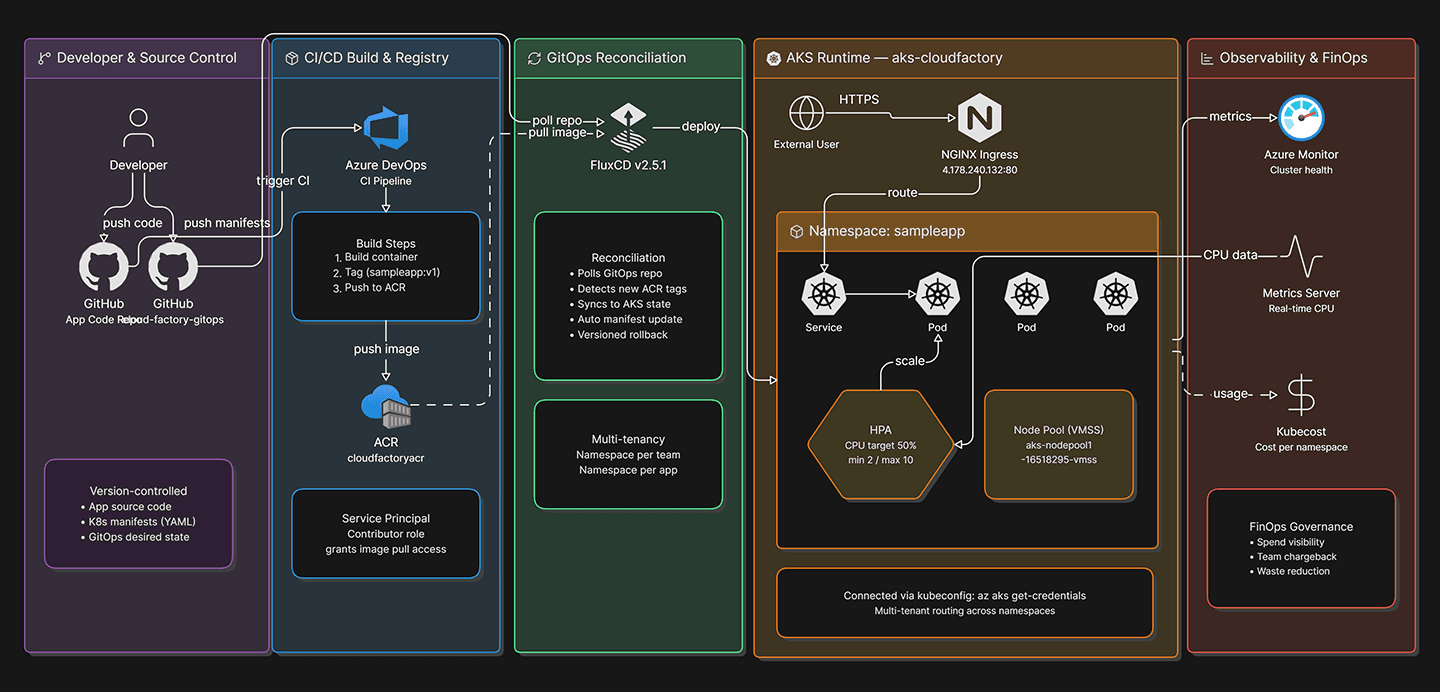
The solution is structured as a six-layer cloud-native application factory integrating source control and CI automation, GitOps deployment orchestration, Kubernetes platform operations, networking and ingress, dynamic scaling, and observability with FinOps governance.
1. Source & Continuous Integration Layer
The source and CI layer standardises application build, validation, and container image packaging workflows through Azure DevOps pipelines.
Source Repositories:
GitHub or Azure Repos for application source code version control
Separate Git repository for Kubernetes manifests and deployment configuration — the GitOps repository managed exclusively by FluxCD
CI Pipelines (Azure DevOps):
Automated container image builds triggered on source code commits to defined branches
Continuous integration validation — unit tests, static analysis, and container security scanning before image publication
Automated image tagging with commit SHA and semantic version for immutable image traceability
Image publishing to Azure Container Registry (ACR) with role-based access control for image pull authorisation
Separation of CI and CD: CI pipelines are responsible exclusively for building, testing, and publishing container images to ACR. They do not deploy to Kubernetes directly. Deployment state is managed exclusively through the GitOps repository and FluxCD — ensuring a clean separation between build governance and deployment governance with independent audit trails for each.
2. GitOps Control Plane
The deployment governance model leverages FluxCD v2 (GitOps Toolkit) for declarative, Git-driven Kubernetes state management.
FluxCD v2 Components:
Source Controller — continuously monitors the GitOps repository for changes to Kubernetes manifests and Helm charts
Kustomize Controller — applies Kustomize-based manifest overlays for environment-specific configuration management
Helm Controller — manages Helm release lifecycle for applications packaged as Helm charts
Notification Controller — sends deployment status alerts to collaboration platforms and monitoring systems
GitOps Operational Model:
Continuous monitoring of the GitOps repository for desired state changes
Automatic reconciliation of Kubernetes cluster state to match the declared Git repository state
Drift detection identifying and correcting any manual changes that diverge from the declared desired state
Complete Git-based deployment audit trail — every deployment, configuration change, and rollback is traceable to a specific Git commit
Managed Resources: Deployments, Services, Ingress configurations, ConfigMaps, HorizontalPodAutoscalers, and Namespace-scoped resources across all team namespaces.
3. Kubernetes Platform Layer
The orchestration layer leverages Azure Kubernetes Service (AKS) as the centralised application hosting platform with Azure CNI networking and enterprise security configuration.
AKS Cluster Configuration:
Component | Configuration | Rationale |
|---|---|---|
Network Plugin | Azure CNI | Native VNet integration, pod-level NSG support, no IP masquerading |
Node Pools | VM Scale Sets | Dynamic scaling, availability zone distribution |
Authentication | Azure RBAC + Kubernetes RBAC | Unified identity governance through Entra ID |
Workload Identity | Azure Workload Identity | Secretless pod authentication to Azure services |
Private Cluster | Optional | API server private endpoint for production environments |
Azure CNI over Kubenet: Azure CNI assigns pods native VNet IP addresses — enabling pod-level Network Security Group enforcement, direct Azure service integration, and consistent network policy application. Kubenet's IP masquerading model creates constraints for enterprise network security governance that Azure CNI eliminates.
Multi-Namespace Architecture:
Namespace | Purpose | Access Boundary |
|---|---|---|
team-a | Team A application workloads | Team A developers only |
team-b | Team B application workloads | Team B developers only |
platform | Shared platform services | Platform engineering team |
monitoring | Observability stack | Platform engineering team |
flux-system | FluxCD controllers | Platform engineering team only |
Security Controls:
Azure Workload Identity replacing Pod Identity v1 for secretless, credential-free pod authentication to Azure Key Vault, ACR, and Azure services
Kubernetes RBAC with namespace-scoped role bindings preventing cross-namespace privilege escalation
Azure Key Vault integration through CSI Secrets Store driver for secure secrets injection without environment variable exposure
Network policies enforcing pod-level east-west traffic control within and between namespaces
4. Networking & Access Layer
Application exposure and routing are implemented through a centralised NGINX Ingress Controller, providing consistent ingress management across all deployed services.
NGINX Ingress Controller:
Centralised routing management for all HTTP and HTTPS application traffic entering the cluster
Path-based and host-based routing rules directing traffic to the appropriate backend services
TLS termination using internally or externally issued certificates managed through cert-manager integration
Rate limiting and connection control for exposed application endpoints
External Access Model:
LoadBalancer service type for NGINX Ingress Controller — single Azure Load Balancer public IP for all ingress traffic
Internal LoadBalancer option for private-facing services accessible only within the VNet
Microservice-to-microservice communication through Kubernetes internal ClusterIP services — not exposed externally
5. Scaling & Performance Layer
Dynamic workload scaling is implemented through Kubernetes-native autoscaling capabilities responding to real-time workload demand.
Horizontal Pod Autoscaler (HPA):
Dynamic pod scaling based on CPU utilisation, memory utilisation, and custom application metrics
Minimum and maximum replica boundaries preventing both under-provisioning and runaway scaling
Scaling policies defining scale-up and scale-down behaviour to prevent thrashing during demand fluctuations
Kubernetes Metrics Server:
Real-time resource utilisation metrics collection from all cluster nodes and pods
Provides the metrics pipeline required by HPA for scaling decision evaluation
Enables kubectl top commands for operational resource visibility
Cluster Autoscaler (Node Pool Scaling):
Automatic node pool scaling adding nodes when pod scheduling is blocked by insufficient cluster capacity
Node pool scale-down removing underutilised nodes during low-demand periods to optimise infrastructure cost
VM Scale Sets integration enabling elastic node pool expansion within defined minimum and maximum boundaries
6. Observability & FinOps Governance Layer
Operational visibility and financial governance are centralised through Azure Monitor and Kubecost, providing unified platform health monitoring and namespace-level cost accountability.
Azure Monitor & Container Insights:
Cluster-level metrics collection — node CPU, memory, disk, and network utilisation
Pod and container-level performance monitoring across all namespaces
Centralised log collection from all cluster components and application workloads
Alert rules for cluster health events, pod restart patterns, and resource threshold breaches
Kubecost — FinOps Governance:
Namespace-level cost allocation providing financial visibility per team and application
Resource consumption analytics breaking down compute, memory, storage, and network costs per workload
Showback model providing cost visibility to engineering teams without direct chargeback enforcement — enabling cost awareness and optimisation without billing friction
Budget alerting thresholds notifying teams approaching defined namespace cost limits
Cost efficiency recommendations identifying oversized workloads and optimisation opportunities
Historical cost trend analysis supporting capacity planning and FinOps governance reporting
Technologies Used
Category | Technologies |
|---|---|
Kubernetes Platform | Azure Kubernetes Service (AKS), Azure CNI, VM Scale Sets |
GitOps | FluxCD v2 (Source, Kustomize, Helm, Notification Controllers) |
CI/CD | Azure DevOps, GitHub |
Container Registry | Azure Container Registry (ACR) |
Networking & Ingress | NGINX Ingress Controller, Azure Load Balancer |
Workload Identity | Azure Workload Identity, Azure Key Vault CSI Driver |
Scaling | Horizontal Pod Autoscaler, Cluster Autoscaler, Metrics Server |
Observability | Azure Monitor, Container Insights |
FinOps Governance | Kubecost |
Automation | PowerShell, Azure CLI, kubectl, Helm |
Key Challenges Addressed
Standardising deployment workflows across multiple teams — addressed through GitOps-driven FluxCD reconciliation enforcing consistent declarative deployment patterns across all team namespaces from a single governed repository model.
Reducing configuration drift and manual deployment errors — addressed through FluxCD drift detection and automatic reconciliation, which detects and corrects any divergence from declared Git state — including manual changes applied directly to the cluster.
Managing Kubernetes scalability across distributed workloads — addressed through HPA for pod-level demand-driven scaling and Cluster Autoscaler for node pool elasticity, enabling the platform to adapt to workload demand without manual intervention.
Enabling developer autonomy while maintaining governance controls — addressed through namespace-based multi-tenancy with scoped RBAC bindings — teams have full deployment autonomy within their namespaces while platform-level guardrails prevent cross-namespace interference.
Providing granular cost visibility per application and namespace — addressed through Kubecost namespace-level cost allocation, providing engineering teams with financial accountability and optimisation visibility previously unavailable in traditional VM-based hosting models.
Secretless pod authentication to Azure services — addressed through Azure Workload Identity replacing credential-based service principal authentication, eliminating secrets management overhead and credential exposure risk for pods authenticating to ACR, Key Vault, and Azure APIs.
Design Decisions & Rationale
GitOps over Traditional Deployment Pipelines : Traditional CI/CD pipelines where the pipeline deploys directly to Kubernetes create an imperative deployment model with limited auditability and no automatic drift correction. FluxCD GitOps establishes Git as the single source of truth for cluster state — deployments are declarative, every change is traced to a Git commit, and drift from desired state is automatically detected and corrected. This fundamentally improves operational governance and deployment reliability.
Separation of CI and CD Responsibilities : Combining build and deployment in a single pipeline creates governance and security risks — a compromised CI pipeline can directly modify production deployments. Separating CI (Azure DevOps — builds and publishes images) from CD (FluxCD — reconciles deployment state) creates independent audit trails and security boundaries for each phase of the delivery lifecycle.
AKS with Azure CNI over Kubenet : Azure CNI assigns pods native VNet IP addresses, enabling pod-level Network Security Group enforcement, direct integration with Azure services without NAT complexity, and consistent network policy application. Kubenet's IP masquerading model limits enterprise network security governance capabilities and creates operational complexity for organisations requiring pod-level network visibility.
Namespace-Based Multi-Tenancy : Without namespace isolation, teams operating in a shared Kubernetes cluster can inadvertently or maliciously interfere with each other's workloads. Namespace-scoped RBAC bindings, resource quotas, and network policies enforce isolation boundaries between teams while preserving the operational efficiency of a shared cluster model.
Azure Workload Identity over Service Principal Credentials : Service principal credentials embedded in pods or environment variables create secret management overhead and credential exposure risk. Azure Workload Identity provides secretless, short-lived token-based authentication to Azure services through federated identity — eliminating credential management entirely for pod-to-Azure-service authentication.
Kubecost for FinOps Visibility : Kubernetes infrastructure costs are invisible without dedicated cost allocation tooling — Azure Monitor provides operational metrics but not workload-level financial attribution. Kubecost provides namespace-level cost visibility that creates financial accountability for engineering teams, enables cost optimisation decisions, and supports FinOps governance reporting that is increasingly expected in enterprise Kubernetes environments.
Dynamic Scaling with HPA and Cluster Autoscaler : Fixed-capacity deployments either over-provision resources wasting cost during low demand, or under-provision creating performance degradation during demand spikes. HPA and Cluster Autoscaler together provide a two-tier elasticity model — pod replicas scale first to absorb demand fluctuations, then node pools scale to accommodate resource requirements that exceed current cluster capacity.
Trade-offs & Design Constraints
GitOps Adoption Complexity for Existing Teams : GitOps requires teams to adopt a declarative, Git-centric operational model that differs significantly from traditional imperative deployment workflows. Teams accustomed to direct kubectl apply or pipeline-driven deployments must adopt new practices around manifest management, Git branching strategies, and FluxCD reconciliation workflows. Change management and documentation investment is essential for successful GitOps adoption across multi-team environments.
Azure CNI IP Address Consumption : Azure CNI assigns a VNet IP address to every pod — consuming significantly more IP address space than Kubenet's overlay model. In large clusters with high pod density, Azure CNI's IP consumption can exhaust VNet CIDR ranges if not planned appropriately. IP address planning must account for maximum pod counts per node, node pool scaling limits, and VNet subnet sizing before selecting Azure CNI for large-scale deployments.
FluxCD Reconciliation Latency : FluxCD reconciles cluster state based on a configured polling interval (typically 1–5 minutes). Deployments are not instantaneous — changes committed to Git are applied after the next reconciliation cycle. For teams expecting immediate deployment feedback, this reconciliation latency requires a mental model shift from pipeline-driven deployments. Notification Controller alerts on reconciliation events mitigate this by providing deployment status feedback to development teams.
Kubecost Accuracy Limitations : Kubecost cost attribution is based on resource requests and limits rather than actual Azure billing data. Actual costs may differ from Kubecost estimates due to reserved instance pricing, spot node discounts, and Azure billing adjustments. Kubecost should be used for relative cost comparison and trend analysis rather than treated as a precise billing replacement — reconciliation against Azure Cost Management data is recommended for accurate financial reporting.
Namespace Multi-Tenancy Security Boundaries : Kubernetes namespace isolation is a soft security boundary — a compromised container with cluster-admin privileges can escape namespace restrictions. For workloads with strict security isolation requirements, namespace-level isolation alone is insufficient. Hard multi-tenancy through separate AKS clusters, or Policy-as-Code enforcement through OPA/Gatekeeper, provides stronger isolation guarantees for high-assurance workload separation.
Projected Outcomes
The architecture is designed to deliver the following operational and platform engineering outcomes in a production enterprise environment:
Standardised, repeatable cloud-native deployments across all engineering teams through GitOps declarative state management
Elimination of deployment configuration drift through FluxCD continuous reconciliation
Accelerated application delivery through automated CI/CD workflows reducing manual deployment steps
Dynamic workload scaling adapting to real-time demand without manual capacity intervention
Improved deployment consistency and reliability across development, staging, and production environments
Namespace-level cost accountability and FinOps visibility enabling engineering team financial governance
Increased developer autonomy within governed platform boundaries through namespace-scoped self-service deployment
Reusable cloud-native platform engineering patterns applicable across multi-team enterprise Kubernetes environments
Future Evolution
Service mesh integration (Istio or Linkerd) for mutual TLS between services, advanced traffic management, and service-level observability
Progressive delivery strategies through Flagger — Canary and Blue-Green deployment patterns with automated rollback on metric degradation
Policy-as-Code enforcement through OPA/Gatekeeper for admission control guardrails preventing non-compliant workload deployment
Advanced FinOps governance automation including automated rightsizing recommendations and budget-driven scaling policies
Kubernetes security posture management through Defender for Containers for runtime threat detection and image vulnerability scanning
Azure Key Vault Secrets Store CSI Driver expansion for comprehensive secrets lifecycle management across all workloads
Multi-cluster federation for geographic distribution, disaster recovery, and workload portability across Azure regions
AI-assisted scaling and anomaly detection through Azure Monitor intelligent alerting and predictive autoscaling
Key Takeaways
Platform engineering improves consistency, governance, and scalability across cloud-native environments — Kubernetes without platform engineering practices becomes operationally unmanageable at multi-team scale
GitOps fundamentally improves deployment governance and operational traceability — Git as the source of truth for cluster state provides auditability and drift correction unavailable in imperative deployment models
Separation of CI and CD responsibilities is a critical security and governance decision — build pipelines and deployment orchestration should maintain independent audit trails and access controls
Azure CNI is the appropriate network plugin for enterprise AKS deployments requiring pod-level network security governance and native VNet integration
Azure Workload Identity eliminates credential management risk for pod-to-Azure-service authentication — secretless authentication should be the default for all AKS workloads
FinOps governance through Kubecost is not optional at enterprise scale — cost visibility and accountability must be built into the platform from the foundation
Namespace isolation is a soft security boundary — hard multi-tenancy requirements demand additional controls through Policy-as-Code or separate cluster isolation
Executive Summary
Architected a cloud-native application delivery platform on Microsoft Azure enabling standardised microservices deployment, GitOps-driven operations, automated CI/CD workflows, dynamic workload scaling, and centralised operational governance across multi-team enterprise environments.
The platform combines Azure Kubernetes Service (AKS) with Azure CNI networking, FluxCD v2 GitOps orchestration, Azure DevOps CI pipelines, Azure Container Registry, NGINX Ingress, Kubernetes-native autoscaling, Azure Monitor observability, and Kubecost FinOps governance — establishing a modern platform engineering model focused on automation, developer autonomy, operational consistency, and cost accountability.
The design demonstrates how platform engineering and GitOps practices can modernise enterprise application delivery — transforming Kubernetes from an infrastructure component into a scalable, governed, and operationally mature application factory.
Business Drivers
Organisations modernising toward microservices and cloud-native application delivery frequently encounter operational and governance challenges caused by fragmented deployment models and inconsistent platform standards across engineering teams.
This architecture was designed to address the platform engineering requirements of organisations where existing approaches result in:
Fragmented deployment pipelines across engineering teams creating inconsistency, configuration drift, and manual error risk
Slow delivery cycles caused by manual release processes and operational bottlenecks between development and infrastructure teams
Lack of standardised deployment environments making consistent testing, staging, and production promotion difficult to enforce
Insufficient visibility into infrastructure and application costs creating FinOps accountability gaps across engineering teams
Difficulty enforcing governance across distributed Kubernetes workloads without central policy and isolation controls
Limited scalability of traditional VM-based application hosting models unable to adapt dynamically to workload demand fluctuations
Operational Constraints
The architecture was designed to operate within the following constraints typical of multi-team enterprise Kubernetes environments:
Multiple engineering teams require isolated deployment environments with workload governance boundaries between them
Application deployments must be repeatable and consistent across development, staging, and production environments
CI/CD workflows require centralised governance without reducing developer agility or introducing deployment bottlenecks
Platform scalability must adapt dynamically to workload demand without manual capacity intervention
Operational visibility must include both performance monitoring and namespace-level cost accountability
Kubernetes operational complexity must be abstracted through standardised workflows enabling developer self-service
Infrastructure configuration must be declarative and auditable — manual configuration changes must be detectable and correctable
Objectives
Provide a standardised, governed cloud-native deployment platform for multi-team enterprise microservices delivery
Enable fully automated GitOps-driven deployments through FluxCD declarative state management
Automate CI pipelines for container image build, test, and publishing workflows
Support dynamic workload scaling based on real-time demand through Kubernetes-native autoscaling
Improve deployment consistency and eliminate configuration drift through declarative reconciliation
Provide namespace-level cost visibility and resource governance through FinOps tooling
Increase developer autonomy through self-service deployment patterns within governed boundaries
Establish reusable cloud-native platform engineering patterns applicable across enterprise Kubernetes environments
Architecture Principles
Declarative infrastructure and deployments — desired state defined in Git, enforced automatically by the platform
GitOps-driven operational governance — Git repository as the single source of truth for all deployment state
Automation-first delivery workflows — manual deployment steps eliminated from the standard delivery path
Immutable deployment practices — container images are versioned and immutable; updates deploy new versions rather than modifying running instances
Namespace-based workload isolation — team and application boundaries enforced through Kubernetes namespace governance
Separation of CI and CD responsibilities — build pipelines and deployment orchestration are independent, separately governed workflows
Centralised observability and governance — operational and cost visibility unified across all namespaces and workloads
Developer self-service enablement within governed boundaries — teams control their deployment workflows within platform-defined guardrails
Security integrated at the platform layer — workload identity, secrets management, and network policies built into the platform foundation
Architecture Overview
The solution is structured as a six-layer cloud-native application factory integrating source control and CI automation, GitOps deployment orchestration, Kubernetes platform operations, networking and ingress, dynamic scaling, and observability with FinOps governance.
1. Source & Continuous Integration Layer
The source and CI layer standardises application build, validation, and container image packaging workflows through Azure DevOps pipelines.
Source Repositories:
GitHub or Azure Repos for application source code version control
Separate Git repository for Kubernetes manifests and deployment configuration — the GitOps repository managed exclusively by FluxCD
CI Pipelines (Azure DevOps):
Automated container image builds triggered on source code commits to defined branches
Continuous integration validation — unit tests, static analysis, and container security scanning before image publication
Automated image tagging with commit SHA and semantic version for immutable image traceability
Image publishing to Azure Container Registry (ACR) with role-based access control for image pull authorisation
Separation of CI and CD: CI pipelines are responsible exclusively for building, testing, and publishing container images to ACR. They do not deploy to Kubernetes directly. Deployment state is managed exclusively through the GitOps repository and FluxCD — ensuring a clean separation between build governance and deployment governance with independent audit trails for each.
2. GitOps Control Plane
The deployment governance model leverages FluxCD v2 (GitOps Toolkit) for declarative, Git-driven Kubernetes state management.
FluxCD v2 Components:
Source Controller — continuously monitors the GitOps repository for changes to Kubernetes manifests and Helm charts
Kustomize Controller — applies Kustomize-based manifest overlays for environment-specific configuration management
Helm Controller — manages Helm release lifecycle for applications packaged as Helm charts
Notification Controller — sends deployment status alerts to collaboration platforms and monitoring systems
GitOps Operational Model:
Continuous monitoring of the GitOps repository for desired state changes
Automatic reconciliation of Kubernetes cluster state to match the declared Git repository state
Drift detection identifying and correcting any manual changes that diverge from the declared desired state
Complete Git-based deployment audit trail — every deployment, configuration change, and rollback is traceable to a specific Git commit
Managed Resources: Deployments, Services, Ingress configurations, ConfigMaps, HorizontalPodAutoscalers, and Namespace-scoped resources across all team namespaces.
3. Kubernetes Platform Layer
The orchestration layer leverages Azure Kubernetes Service (AKS) as the centralised application hosting platform with Azure CNI networking and enterprise security configuration.
AKS Cluster Configuration:
Component | Configuration | Rationale |
|---|---|---|
Network Plugin | Azure CNI | Native VNet integration, pod-level NSG support, no IP masquerading |
Node Pools | VM Scale Sets | Dynamic scaling, availability zone distribution |
Authentication | Azure RBAC + Kubernetes RBAC | Unified identity governance through Entra ID |
Workload Identity | Azure Workload Identity | Secretless pod authentication to Azure services |
Private Cluster | Optional | API server private endpoint for production environments |
Azure CNI over Kubenet: Azure CNI assigns pods native VNet IP addresses — enabling pod-level Network Security Group enforcement, direct Azure service integration, and consistent network policy application. Kubenet's IP masquerading model creates constraints for enterprise network security governance that Azure CNI eliminates.
Multi-Namespace Architecture:
Namespace | Purpose | Access Boundary |
|---|---|---|
team-a | Team A application workloads | Team A developers only |
team-b | Team B application workloads | Team B developers only |
platform | Shared platform services | Platform engineering team |
monitoring | Observability stack | Platform engineering team |
flux-system | FluxCD controllers | Platform engineering team only |
Security Controls:
Azure Workload Identity replacing Pod Identity v1 for secretless, credential-free pod authentication to Azure Key Vault, ACR, and Azure services
Kubernetes RBAC with namespace-scoped role bindings preventing cross-namespace privilege escalation
Azure Key Vault integration through CSI Secrets Store driver for secure secrets injection without environment variable exposure
Network policies enforcing pod-level east-west traffic control within and between namespaces
4. Networking & Access Layer
Application exposure and routing are implemented through a centralised NGINX Ingress Controller, providing consistent ingress management across all deployed services.
NGINX Ingress Controller:
Centralised routing management for all HTTP and HTTPS application traffic entering the cluster
Path-based and host-based routing rules directing traffic to the appropriate backend services
TLS termination using internally or externally issued certificates managed through cert-manager integration
Rate limiting and connection control for exposed application endpoints
External Access Model:
LoadBalancer service type for NGINX Ingress Controller — single Azure Load Balancer public IP for all ingress traffic
Internal LoadBalancer option for private-facing services accessible only within the VNet
Microservice-to-microservice communication through Kubernetes internal ClusterIP services — not exposed externally
5. Scaling & Performance Layer
Dynamic workload scaling is implemented through Kubernetes-native autoscaling capabilities responding to real-time workload demand.
Horizontal Pod Autoscaler (HPA):
Dynamic pod scaling based on CPU utilisation, memory utilisation, and custom application metrics
Minimum and maximum replica boundaries preventing both under-provisioning and runaway scaling
Scaling policies defining scale-up and scale-down behaviour to prevent thrashing during demand fluctuations
Kubernetes Metrics Server:
Real-time resource utilisation metrics collection from all cluster nodes and pods
Provides the metrics pipeline required by HPA for scaling decision evaluation
Enables kubectl top commands for operational resource visibility
Cluster Autoscaler (Node Pool Scaling):
Automatic node pool scaling adding nodes when pod scheduling is blocked by insufficient cluster capacity
Node pool scale-down removing underutilised nodes during low-demand periods to optimise infrastructure cost
VM Scale Sets integration enabling elastic node pool expansion within defined minimum and maximum boundaries
6. Observability & FinOps Governance Layer
Operational visibility and financial governance are centralised through Azure Monitor and Kubecost, providing unified platform health monitoring and namespace-level cost accountability.
Azure Monitor & Container Insights:
Cluster-level metrics collection — node CPU, memory, disk, and network utilisation
Pod and container-level performance monitoring across all namespaces
Centralised log collection from all cluster components and application workloads
Alert rules for cluster health events, pod restart patterns, and resource threshold breaches
Kubecost — FinOps Governance:
Namespace-level cost allocation providing financial visibility per team and application
Resource consumption analytics breaking down compute, memory, storage, and network costs per workload
Showback model providing cost visibility to engineering teams without direct chargeback enforcement — enabling cost awareness and optimisation without billing friction
Budget alerting thresholds notifying teams approaching defined namespace cost limits
Cost efficiency recommendations identifying oversized workloads and optimisation opportunities
Historical cost trend analysis supporting capacity planning and FinOps governance reporting
Technologies Used
Category | Technologies |
|---|---|
Kubernetes Platform | Azure Kubernetes Service (AKS), Azure CNI, VM Scale Sets |
GitOps | FluxCD v2 (Source, Kustomize, Helm, Notification Controllers) |
CI/CD | Azure DevOps, GitHub |
Container Registry | Azure Container Registry (ACR) |
Networking & Ingress | NGINX Ingress Controller, Azure Load Balancer |
Workload Identity | Azure Workload Identity, Azure Key Vault CSI Driver |
Scaling | Horizontal Pod Autoscaler, Cluster Autoscaler, Metrics Server |
Observability | Azure Monitor, Container Insights |
FinOps Governance | Kubecost |
Automation | PowerShell, Azure CLI, kubectl, Helm |
Key Challenges Addressed
Standardising deployment workflows across multiple teams — addressed through GitOps-driven FluxCD reconciliation enforcing consistent declarative deployment patterns across all team namespaces from a single governed repository model.
Reducing configuration drift and manual deployment errors — addressed through FluxCD drift detection and automatic reconciliation, which detects and corrects any divergence from declared Git state — including manual changes applied directly to the cluster.
Managing Kubernetes scalability across distributed workloads — addressed through HPA for pod-level demand-driven scaling and Cluster Autoscaler for node pool elasticity, enabling the platform to adapt to workload demand without manual intervention.
Enabling developer autonomy while maintaining governance controls — addressed through namespace-based multi-tenancy with scoped RBAC bindings — teams have full deployment autonomy within their namespaces while platform-level guardrails prevent cross-namespace interference.
Providing granular cost visibility per application and namespace — addressed through Kubecost namespace-level cost allocation, providing engineering teams with financial accountability and optimisation visibility previously unavailable in traditional VM-based hosting models.
Secretless pod authentication to Azure services — addressed through Azure Workload Identity replacing credential-based service principal authentication, eliminating secrets management overhead and credential exposure risk for pods authenticating to ACR, Key Vault, and Azure APIs.
Design Decisions & Rationale
GitOps over Traditional Deployment Pipelines : Traditional CI/CD pipelines where the pipeline deploys directly to Kubernetes create an imperative deployment model with limited auditability and no automatic drift correction. FluxCD GitOps establishes Git as the single source of truth for cluster state — deployments are declarative, every change is traced to a Git commit, and drift from desired state is automatically detected and corrected. This fundamentally improves operational governance and deployment reliability.
Separation of CI and CD Responsibilities : Combining build and deployment in a single pipeline creates governance and security risks — a compromised CI pipeline can directly modify production deployments. Separating CI (Azure DevOps — builds and publishes images) from CD (FluxCD — reconciles deployment state) creates independent audit trails and security boundaries for each phase of the delivery lifecycle.
AKS with Azure CNI over Kubenet : Azure CNI assigns pods native VNet IP addresses, enabling pod-level Network Security Group enforcement, direct integration with Azure services without NAT complexity, and consistent network policy application. Kubenet's IP masquerading model limits enterprise network security governance capabilities and creates operational complexity for organisations requiring pod-level network visibility.
Namespace-Based Multi-Tenancy : Without namespace isolation, teams operating in a shared Kubernetes cluster can inadvertently or maliciously interfere with each other's workloads. Namespace-scoped RBAC bindings, resource quotas, and network policies enforce isolation boundaries between teams while preserving the operational efficiency of a shared cluster model.
Azure Workload Identity over Service Principal Credentials : Service principal credentials embedded in pods or environment variables create secret management overhead and credential exposure risk. Azure Workload Identity provides secretless, short-lived token-based authentication to Azure services through federated identity — eliminating credential management entirely for pod-to-Azure-service authentication.
Kubecost for FinOps Visibility : Kubernetes infrastructure costs are invisible without dedicated cost allocation tooling — Azure Monitor provides operational metrics but not workload-level financial attribution. Kubecost provides namespace-level cost visibility that creates financial accountability for engineering teams, enables cost optimisation decisions, and supports FinOps governance reporting that is increasingly expected in enterprise Kubernetes environments.
Dynamic Scaling with HPA and Cluster Autoscaler : Fixed-capacity deployments either over-provision resources wasting cost during low demand, or under-provision creating performance degradation during demand spikes. HPA and Cluster Autoscaler together provide a two-tier elasticity model — pod replicas scale first to absorb demand fluctuations, then node pools scale to accommodate resource requirements that exceed current cluster capacity.
Trade-offs & Design Constraints
GitOps Adoption Complexity for Existing Teams : GitOps requires teams to adopt a declarative, Git-centric operational model that differs significantly from traditional imperative deployment workflows. Teams accustomed to direct kubectl apply or pipeline-driven deployments must adopt new practices around manifest management, Git branching strategies, and FluxCD reconciliation workflows. Change management and documentation investment is essential for successful GitOps adoption across multi-team environments.
Azure CNI IP Address Consumption : Azure CNI assigns a VNet IP address to every pod — consuming significantly more IP address space than Kubenet's overlay model. In large clusters with high pod density, Azure CNI's IP consumption can exhaust VNet CIDR ranges if not planned appropriately. IP address planning must account for maximum pod counts per node, node pool scaling limits, and VNet subnet sizing before selecting Azure CNI for large-scale deployments.
FluxCD Reconciliation Latency : FluxCD reconciles cluster state based on a configured polling interval (typically 1–5 minutes). Deployments are not instantaneous — changes committed to Git are applied after the next reconciliation cycle. For teams expecting immediate deployment feedback, this reconciliation latency requires a mental model shift from pipeline-driven deployments. Notification Controller alerts on reconciliation events mitigate this by providing deployment status feedback to development teams.
Kubecost Accuracy Limitations : Kubecost cost attribution is based on resource requests and limits rather than actual Azure billing data. Actual costs may differ from Kubecost estimates due to reserved instance pricing, spot node discounts, and Azure billing adjustments. Kubecost should be used for relative cost comparison and trend analysis rather than treated as a precise billing replacement — reconciliation against Azure Cost Management data is recommended for accurate financial reporting.
Namespace Multi-Tenancy Security Boundaries : Kubernetes namespace isolation is a soft security boundary — a compromised container with cluster-admin privileges can escape namespace restrictions. For workloads with strict security isolation requirements, namespace-level isolation alone is insufficient. Hard multi-tenancy through separate AKS clusters, or Policy-as-Code enforcement through OPA/Gatekeeper, provides stronger isolation guarantees for high-assurance workload separation.
Projected Outcomes
The architecture is designed to deliver the following operational and platform engineering outcomes in a production enterprise environment:
Standardised, repeatable cloud-native deployments across all engineering teams through GitOps declarative state management
Elimination of deployment configuration drift through FluxCD continuous reconciliation
Accelerated application delivery through automated CI/CD workflows reducing manual deployment steps
Dynamic workload scaling adapting to real-time demand without manual capacity intervention
Improved deployment consistency and reliability across development, staging, and production environments
Namespace-level cost accountability and FinOps visibility enabling engineering team financial governance
Increased developer autonomy within governed platform boundaries through namespace-scoped self-service deployment
Reusable cloud-native platform engineering patterns applicable across multi-team enterprise Kubernetes environments
Future Evolution
Service mesh integration (Istio or Linkerd) for mutual TLS between services, advanced traffic management, and service-level observability
Progressive delivery strategies through Flagger — Canary and Blue-Green deployment patterns with automated rollback on metric degradation
Policy-as-Code enforcement through OPA/Gatekeeper for admission control guardrails preventing non-compliant workload deployment
Advanced FinOps governance automation including automated rightsizing recommendations and budget-driven scaling policies
Kubernetes security posture management through Defender for Containers for runtime threat detection and image vulnerability scanning
Azure Key Vault Secrets Store CSI Driver expansion for comprehensive secrets lifecycle management across all workloads
Multi-cluster federation for geographic distribution, disaster recovery, and workload portability across Azure regions
AI-assisted scaling and anomaly detection through Azure Monitor intelligent alerting and predictive autoscaling
Key Takeaways
Platform engineering improves consistency, governance, and scalability across cloud-native environments — Kubernetes without platform engineering practices becomes operationally unmanageable at multi-team scale
GitOps fundamentally improves deployment governance and operational traceability — Git as the source of truth for cluster state provides auditability and drift correction unavailable in imperative deployment models
Separation of CI and CD responsibilities is a critical security and governance decision — build pipelines and deployment orchestration should maintain independent audit trails and access controls
Azure CNI is the appropriate network plugin for enterprise AKS deployments requiring pod-level network security governance and native VNet integration
Azure Workload Identity eliminates credential management risk for pod-to-Azure-service authentication — secretless authentication should be the default for all AKS workloads
FinOps governance through Kubecost is not optional at enterprise scale — cost visibility and accountability must be built into the platform from the foundation
Namespace isolation is a soft security boundary — hard multi-tenancy requirements demand additional controls through Policy-as-Code or separate cluster isolation