
Description
This case study is an independent architecture design exercise developed to demonstrate secure file transfer architecture methodology for regulated enterprise environments. It was not associated with a production deployment. The scenario is based on the security, compliance, and governance requirements typical of organisations exchanging sensitive data across internal teams, external partners, and regulated systems.
This case study is an independent architecture design exercise developed to demonstrate secure file transfer architecture methodology for regulated enterprise environments. It was not associated with a production deployment. The scenario is based on the security, compliance, and governance requirements typical of organisations exchanging sensitive data across internal teams, external partners, and regulated systems.
Key Focus Areas:
Secure File Transfer Architecture
Linux Hardening & Integrity Monitoring
Centralised Logging & SIEM Integration
Data Protection & DLP Enforcement
Zero Trust Access Controls
CIS & NIST Alignment
Executive Summary
Architected a hardened secure file transfer gateway platform enabling encrypted enterprise-grade data exchange with integrated auditability, file integrity monitoring, centralised observability, and persistent data protection enforcement for regulated environments.
The architecture combines secure SFTP-based transfer mechanisms, CIS-aligned Linux system hardening, AIDE-based file integrity monitoring, Azure-native centralised logging, and Microsoft Information Protection (MIP) to establish a Zero Trust-aligned platform for sensitive data exchange across internal and external stakeholders.
The design addresses operational security, compliance, and governance requirements for organisations handling regulated or confidential information — demonstrating how secure file transfer infrastructure can evolve from a basic transport mechanism into a fully governed, compliance-oriented data exchange service.
Business Drivers
Organisations exchanging sensitive files across internal teams, external partners, or regulated systems increasingly face security and compliance challenges due to fragmented, poorly governed transfer mechanisms. Plaintext protocols, weak authentication, absent audit trails, and lack of data classification controls create significant exposure in environments subject to GDPR, PCI DSS, or internal governance frameworks.
This architecture was designed to address the secure file transfer requirements of organisations where existing exchange approaches lack sufficient governance, monitoring, integrity validation, and persistent data protection controls.
Key drivers include:
Elimination of insecure or unencrypted file transfer practices across the organisation
Protection of sensitive business and customer data during transit and at rest
Centralised visibility and auditability of all file transfer activities
Reduction of insider and unauthorised access risks through strict access governance
Integration of data classification and persistent protection controls beyond transport boundaries
Alignment with GDPR, PCI DSS, CIS Controls v8, and NIST SP 800-53 security requirements
Operational Constraints
The architecture was designed to operate within the following constraints typical of regulated enterprise environments:
File transfer operations must remain operationally simple for end users despite layered security controls
Sensitive data requires encrypted transmission and strictly controlled access at all stages
User isolation must be enforced within shared infrastructure to prevent lateral movement between accounts
Linux-based systems require integration with centralised cloud monitoring platforms
Security hardening controls must not introduce operational disruption to transfer workflows
Audit and integrity monitoring must operate with low overhead to avoid performance degradation
Data protection policies must persist beyond file transfer boundaries into downstream systems
Architecture must balance usability, operational efficiency, and enterprise-grade security enforcement
Objectives
Establish a hardened, encrypted file transfer platform resistant to credential and brute-force attacks
Enforce strong key-based authentication and strict per-user isolation controls
Provide complete auditability of all transfer activities for compliance and forensic purposes
Detect unauthorised file or system modifications through continuous integrity monitoring
Centralise monitoring and log collection into a SIEM-ready observability platform
Integrate file classification and persistent DLP enforcement extending beyond transport boundaries
Align the solution with CIS Controls v8, NIST SP 800-53, GDPR, and PCI DSS requirements
Create a reusable, scalable secure transfer architecture applicable across regulated environments
Compliance Framework Mapping
Control Area | Framework Requirement | Architectural Control |
|---|---|---|
Encrypted transmission | PCI DSS Req. 4, GDPR Art. 32 | SFTP with RSA 4096-bit key authentication |
Access control & authentication | PCI DSS Req. 8, NIST AC-2 | SSH key-only auth, chroot jail isolation |
Audit logging | PCI DSS Req. 10, GDPR Art. 5 | Auditd, Azure Log Analytics |
System integrity | NIST SI-7, CIS Control 10 | AIDE file integrity monitoring |
System hardening | CIS Controls v8, NIST CM-6 | CIS-CAT, Lynis benchmark validation |
Data protection | GDPR Art. 25, PCI DSS Req. 3 | Microsoft Information Protection labels |
Network segmentation | PCI DSS Req. 1, NIST SC-7 | NSG, UFW, private IP access controls |
Architecture Principles
Zero Trust access enforcement — no implicit trust between users, systems, or network positions
Encryption-first communication — no unencrypted transfer paths permitted at any layer
Least-privilege operational access — users access only their isolated transfer directories
Strong identity-based authentication — password-based access eliminated entirely
Continuous auditability and observability — every transfer and system event logged and centralised
Tamper detection and integrity validation — unauthorised system changes detected proactively
Data-centric protection — security enforcement persists beyond network and transport boundaries
Compliance-oriented system hardening — CIS benchmark alignment validated through automated tooling
Centralised governance and monitoring — operational visibility unified across all platform layers
Architecture Overview
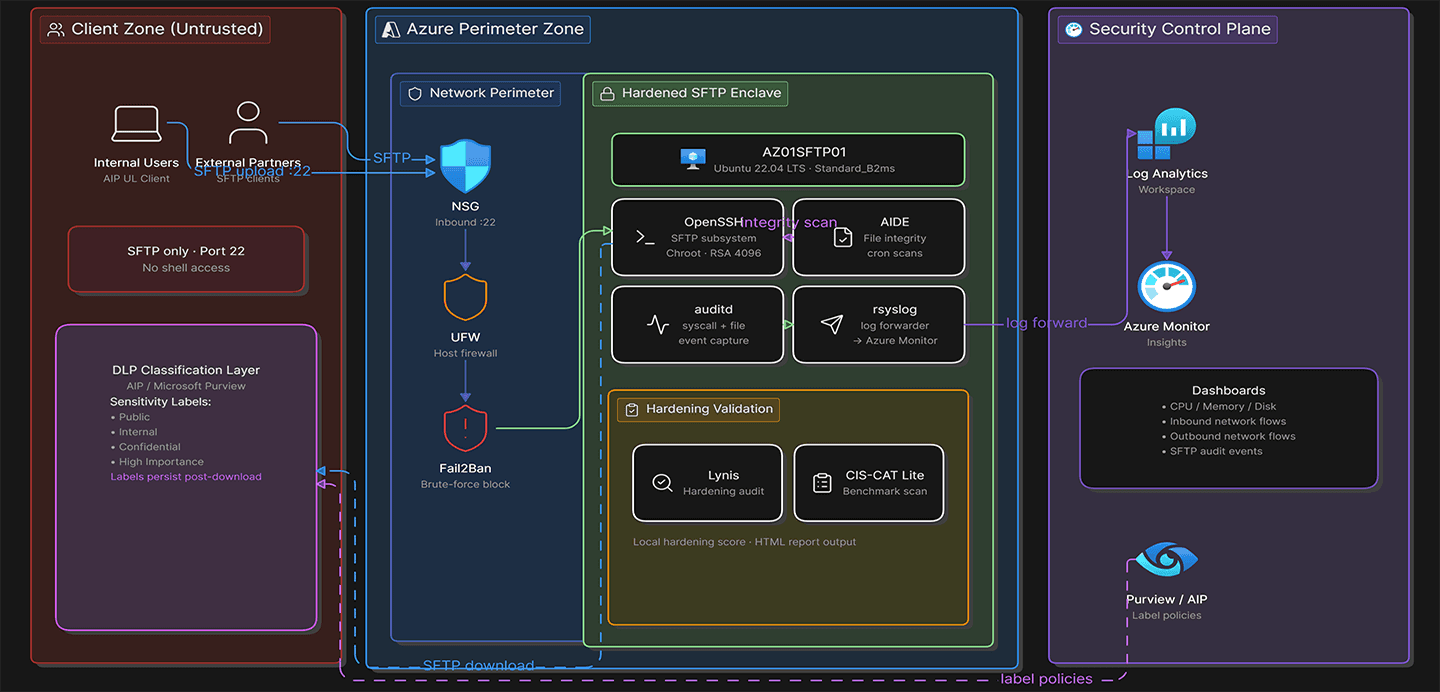
The solution is structured as a six-layer hardened file transfer platform integrating secure access, system hardening, integrity monitoring, centralised observability, data protection enforcement, and secure infrastructure hosting.
1. Access Layer — Secure File Transfer
The transfer layer leverages OpenSSH configured in a restricted SFTP-only operational model with RSA 4096-bit key-based authentication.
Capabilities:
SFTP-only access with shell access completely disabled at the SSH configuration level
RSA 4096-bit SSH key-based authentication as the sole permitted authentication mechanism
Password-based authentication disabled system-wide, eliminating credential theft and brute-force attack vectors
Chroot jail isolation enforced per user, restricting each account to its designated transfer directory and preventing lateral movement to other user spaces or system paths
Encrypted file transfer communications with no plaintext transmission paths
This layer minimises attack surface by restricting the gateway to its sole legitimate function — encrypted file transfer — with no ancillary capabilities exposed.
2. Security & Hardening Layer
The operating environment is hardened using CIS Benchmark-aligned security controls, validated through automated tooling.
Controls:
UFW (Uncomplicated Firewall) enforcement restricting inbound connectivity to SFTP port only
Fail2Ban brute-force protection automatically blocking sources generating failed authentication attempts
CIS Ubuntu Linux Benchmark validation using CIS-CAT automated scanning
Lynis security auditing for ongoing host hardening assessment and gap identification
Disabled and removed unnecessary services, daemons, and network-exposed ports
Kernel parameter hardening through sysctl configuration
Automated benchmark validation through CIS-CAT ensures hardening controls are measurably aligned to recognised enterprise security standards rather than informally applied.
3. Integrity Monitoring Layer
File and system integrity controls are implemented to detect unauthorised modifications and support operational forensics.
Capabilities:
AIDE (Advanced Intrusion Detection Environment) file integrity monitoring establishing cryptographic baselines of critical system files and transfer directories
Scheduled integrity scans comparing current system state against established baselines and alerting on deviations
Auditd system-level auditing capturing privileged operations, file access events, and authentication activities
Monitoring of sensitive system paths including SSH configuration, user directories, and system binaries
Detection of unexpected system changes providing early warning of potential compromise or insider activity
AIDE provides tamper detection at the file system level — detecting modifications that may evade network-level monitoring — and supports post-incident forensic reconstruction of system changes.
4. Logging & Monitoring Layer
Centralised observability is implemented through Azure Monitor Agent integration with a Log Analytics Workspace, enabling SIEM-ready log aggregation from the Linux-based gateway.
Capabilities:
Azure Monitor Agent deployed on the Ubuntu gateway, forwarding logs to a centralised Log Analytics Workspace
Centralised collection of SSH access logs, authentication events, system logs, Auditd events, and security activity
SIEM-ready log aggregation enabling correlation with broader enterprise security monitoring platforms
Alerting configuration for anomalous access patterns, failed authentication bursts, and integrity scan failures
Unified operational visibility across transfer activity, system health, and security events
Centralising Linux-based operational logs into Azure-native monitoring eliminates the visibility gap common in hybrid environments where Linux systems operate outside enterprise monitoring scope.
5. Data Protection Layer — DLP Enforcement
Persistent data protection controls are implemented using Microsoft Information Protection (MIP), extending security enforcement beyond the transport boundary into the data itself.
Capabilities:
Sensitivity labels applied to classified files prior to transfer, defining protection policies that persist with the file regardless of destination
File classification controls enabling identification and labelling of sensitive content before exchange
Persistent encryption enforced through MIP protection policies, ensuring files remain protected after delivery to recipients
Access control enforcement at the file level, restricting opening and modification to authorised identities even after transfer completion
Integration Note: In a Linux-based SFTP environment, MIP label enforcement is implemented at the client side — users applying sensitivity labels through MIP-enabled applications (Microsoft 365) before placing files in the transfer directory. The SFTP gateway handles encrypted transport; MIP handles persistent data-level protection. This hybrid enforcement model extends protection beyond what network-layer controls alone can provide.
6. Infrastructure Layer
The platform is hosted on a hardened Azure virtual machine with network-level controls enforcing minimal exposure.
Components:
Azure Virtual Machine running Ubuntu Server 22.04 LTS or 24.04 LTS
Network Security Groups (NSGs) restricting inbound traffic to SFTP port from authorised source ranges only
UFW host firewall providing a secondary network control layer at the OS level
Private IP-based access controls limiting direct internet exposure
Optional extension models: Azure Bastion for administrative access and Just-in-Time (JIT) VM access for privileged operations
Technologies Used
Category | Technologies |
|---|---|
Operating System | Ubuntu Server 22.04 / 24.04 LTS |
Secure File Transfer | OpenSSH (SFTP Subsystem) |
Authentication | SSH Key-Based Authentication (RSA 4096-bit) |
User Isolation | Chroot Jail |
Security Hardening | UFW, Fail2Ban, Lynis, CIS-CAT |
Integrity Monitoring | AIDE, Auditd |
Monitoring & Observability | Azure Monitor Agent, Log Analytics Workspace |
Data Protection | Microsoft Information Protection (MIP) |
Infrastructure Platform | Microsoft Azure Virtual Machine |
Compliance Frameworks | CIS Controls v8, NIST SP 800-53, GDPR, PCI DSS |
Key Challenges Addressed
Securing file transfer operations without excessive operational complexity — addressed through SFTP-only restriction and SSH key authentication, which are operationally straightforward for users while eliminating the attack surface of shell access and password-based credentials.
Enforcing strict user isolation within shared infrastructure — addressed through per-user chroot jail configuration, preventing any user from accessing other users' transfer directories or system paths regardless of their authentication status.
Detecting unauthorised file and system modifications — addressed through AIDE baseline monitoring and Auditd system auditing, providing cryptographic tamper detection at the file system level beyond what network monitoring can observe.
Centralising Linux-based operational logs into Azure monitoring platforms — addressed through Azure Monitor Agent deployment on the Ubuntu gateway, bridging the visibility gap between Linux infrastructure and Azure-native SIEM capabilities.
Integrating persistent data protection into a file transfer workflow — addressed through MIP client-side label enforcement prior to transfer, extending protection beyond the transport boundary into the file itself regardless of downstream destination.
Aligning hardening controls with recognised compliance standards — addressed through CIS-CAT automated benchmark scanning and Lynis auditing, providing measurable and auditable compliance validation rather than informally applied controls.
Design Decisions & Rationale
SFTP over Traditional FTP Protocols : FTP transmits credentials and data in plaintext, creating unacceptable exposure in regulated environments. SFTP encrypts both authentication and data transmission within the SSH protocol, eliminating plaintext credential interception risk while maintaining operational simplicity for end users.
SSH Key-Based Authentication Only — No Passwords : Password-based SSH authentication is vulnerable to brute-force attacks, credential stuffing, and phishing. RSA 4096-bit key-based authentication eliminates these attack vectors entirely — a stolen password has no value without the corresponding private key. Fail2Ban provides an additional defensive layer against automated brute-force attempts.
Chroot Jail Isolation per User : Without isolation controls, a compromised user account could potentially traverse the file system beyond its intended scope. Chroot jail configuration constrains each user account to its designated transfer directory, eliminating lateral movement capability and enforcing strict operational boundaries between transfer accounts within shared infrastructure.
AIDE for File Integrity Monitoring : Intrusion detection at the network layer cannot detect file-level modifications made by privileged or compromised accounts already inside the system. AIDE establishes cryptographic baselines of critical files and detects deviations — providing a detection layer that complements network monitoring and supports forensic investigation.
Centralised Monitoring Through Azure : Operating Linux-based systems outside centralised monitoring creates blind spots in enterprise security visibility. Azure Monitor Agent integration brings the SFTP gateway into the same observability and alerting framework as other Azure-hosted infrastructure, enabling correlated threat detection across the environment.
Data-Centric Security Through Microsoft Information Protection : Network-layer and transport-layer protections secure data in transit but provide no protection once a file reaches its destination. MIP sensitivity labels and persistent encryption extend security enforcement into the file itself — ensuring classified data remains protected regardless of where it is stored or forwarded after transfer.
CIS-Aligned Hardening Strategy : Informal hardening without benchmark validation leaves gaps that are difficult to audit or demonstrate to compliance reviewers. CIS-CAT automated scanning against the CIS Ubuntu Linux Benchmark provides measurable, repeatable, and auditable hardening validation aligned to a recognised industry standard.
Trade-offs & Design Constraints
MIP Integration Complexity in Linux Environments : Microsoft Information Protection is natively integrated with Windows and Microsoft 365 environments. In a Linux-based SFTP context, label enforcement relies on client-side application of sensitivity labels before files enter the transfer workflow — the Linux gateway itself does not natively enforce MIP policies. This hybrid model extends protection effectively but requires user discipline and MIP-enabled client applications. Organisations requiring server-side DLP enforcement on Linux may need to evaluate additional tooling such as Microsoft Purview Data Loss Prevention policies or third-party DLP agents.
Chroot Jail Administrative Overhead : Per-user chroot jail configuration requires careful directory structure management and ownership settings. In environments with large numbers of transfer users, managing chroot configurations at scale introduces administrative overhead. Infrastructure as Code automation (Ansible, Terraform) is recommended for consistent and auditable user provisioning at scale.
AIDE Scan Performance on Large File Systems : AIDE integrity scans against large file systems or high-frequency transfer directories can introduce I/O overhead during scheduled scan windows. Scan scheduling should be aligned to off-peak transfer periods, and monitored paths should be scoped to security-relevant system directories rather than the full transfer data volume to maintain acceptable performance.
Log Analytics Workspace Cost at Scale : Azure Monitor Log Analytics pricing is volume-based. In high-throughput transfer environments generating large volumes of SSH access logs and Auditd events, ingestion costs can become significant. Log filtering and sampling strategies should be designed to retain security-relevant events while managing ingestion volume — retaining full fidelity for authentication, integrity, and privileged operation events while applying sampling to routine transfer activity logs.
Projected Outcomes
The architecture is designed to deliver the following operational and security outcomes in a production regulated environment:
Fully encrypted file transfer communications with no plaintext transmission paths at any layer
Elimination of credential-based attack vectors through RSA 4096-bit key-only authentication
Complete auditability of user activity and transfer operations through Auditd and centralised log collection
Proactive detection of unauthorised file and system modifications through AIDE integrity monitoring
Centralised operational visibility through Azure Monitor and Log Analytics SIEM integration
Persistent data protection extending beyond transport boundaries through MIP classification and encryption
Measurably reduced risk of data exposure and compliance violations in regulated environments
CIS and NIST-aligned hardening posture validated through automated benchmark tooling
Reusable, scalable enterprise transfer architecture applicable across regulated and compliance-sensitive environments
Future Evolution
Integration with Microsoft Sentinel for advanced threat detection and automated incident response workflows
SOAR integration enabling automated response to detected integrity violations or brute-force events
Secure API-based transfer orchestration for automated system-to-system data exchange workflows
Multi-region high-availability architecture for business continuity and geographic resilience
Advanced behavioural anomaly detection for identification of unusual transfer patterns
Infrastructure as Code deployment automation (Ansible, Terraform) for consistent, auditable provisioning at scale
Enterprise identity federation integration (Azure AD / Entra ID) for centralised user lifecycle management
Managed File Transfer (MFT) workflow expansion supporting advanced scheduling, retry logic, and transfer governance
Key Takeaways
Secure file transfer platforms require layered security controls across access, hardening, integrity, monitoring, and data protection — transport encryption alone is insufficient
Data protection must extend beyond transport boundaries through persistent classification and encryption policies
Centralised observability is critical for operational trust, compliance audit readiness, and threat correlation
File integrity monitoring at the system level provides a detection capability that complements but cannot be replaced by network-layer monitoring
CIS benchmark-aligned hardening validated through automated tooling provides measurable, auditable compliance evidence rather than informally applied controls
Zero Trust principles — no implicit trust, strict identity verification, least-privilege access — are directly applicable and highly effective in enterprise file transfer architectures
Chroot jail isolation is a simple but highly effective control for preventing lateral movement within shared transfer infrastructure
Executive Summary
Architected a hardened secure file transfer gateway platform enabling encrypted enterprise-grade data exchange with integrated auditability, file integrity monitoring, centralised observability, and persistent data protection enforcement for regulated environments.
The architecture combines secure SFTP-based transfer mechanisms, CIS-aligned Linux system hardening, AIDE-based file integrity monitoring, Azure-native centralised logging, and Microsoft Information Protection (MIP) to establish a Zero Trust-aligned platform for sensitive data exchange across internal and external stakeholders.
The design addresses operational security, compliance, and governance requirements for organisations handling regulated or confidential information — demonstrating how secure file transfer infrastructure can evolve from a basic transport mechanism into a fully governed, compliance-oriented data exchange service.
Business Drivers
Organisations exchanging sensitive files across internal teams, external partners, or regulated systems increasingly face security and compliance challenges due to fragmented, poorly governed transfer mechanisms. Plaintext protocols, weak authentication, absent audit trails, and lack of data classification controls create significant exposure in environments subject to GDPR, PCI DSS, or internal governance frameworks.
This architecture was designed to address the secure file transfer requirements of organisations where existing exchange approaches lack sufficient governance, monitoring, integrity validation, and persistent data protection controls.
Key drivers include:
Elimination of insecure or unencrypted file transfer practices across the organisation
Protection of sensitive business and customer data during transit and at rest
Centralised visibility and auditability of all file transfer activities
Reduction of insider and unauthorised access risks through strict access governance
Integration of data classification and persistent protection controls beyond transport boundaries
Alignment with GDPR, PCI DSS, CIS Controls v8, and NIST SP 800-53 security requirements
Operational Constraints
The architecture was designed to operate within the following constraints typical of regulated enterprise environments:
File transfer operations must remain operationally simple for end users despite layered security controls
Sensitive data requires encrypted transmission and strictly controlled access at all stages
User isolation must be enforced within shared infrastructure to prevent lateral movement between accounts
Linux-based systems require integration with centralised cloud monitoring platforms
Security hardening controls must not introduce operational disruption to transfer workflows
Audit and integrity monitoring must operate with low overhead to avoid performance degradation
Data protection policies must persist beyond file transfer boundaries into downstream systems
Architecture must balance usability, operational efficiency, and enterprise-grade security enforcement
Objectives
Establish a hardened, encrypted file transfer platform resistant to credential and brute-force attacks
Enforce strong key-based authentication and strict per-user isolation controls
Provide complete auditability of all transfer activities for compliance and forensic purposes
Detect unauthorised file or system modifications through continuous integrity monitoring
Centralise monitoring and log collection into a SIEM-ready observability platform
Integrate file classification and persistent DLP enforcement extending beyond transport boundaries
Align the solution with CIS Controls v8, NIST SP 800-53, GDPR, and PCI DSS requirements
Create a reusable, scalable secure transfer architecture applicable across regulated environments
Compliance Framework Mapping
Control Area | Framework Requirement | Architectural Control |
|---|---|---|
Encrypted transmission | PCI DSS Req. 4, GDPR Art. 32 | SFTP with RSA 4096-bit key authentication |
Access control & authentication | PCI DSS Req. 8, NIST AC-2 | SSH key-only auth, chroot jail isolation |
Audit logging | PCI DSS Req. 10, GDPR Art. 5 | Auditd, Azure Log Analytics |
System integrity | NIST SI-7, CIS Control 10 | AIDE file integrity monitoring |
System hardening | CIS Controls v8, NIST CM-6 | CIS-CAT, Lynis benchmark validation |
Data protection | GDPR Art. 25, PCI DSS Req. 3 | Microsoft Information Protection labels |
Network segmentation | PCI DSS Req. 1, NIST SC-7 | NSG, UFW, private IP access controls |
Architecture Principles
Zero Trust access enforcement — no implicit trust between users, systems, or network positions
Encryption-first communication — no unencrypted transfer paths permitted at any layer
Least-privilege operational access — users access only their isolated transfer directories
Strong identity-based authentication — password-based access eliminated entirely
Continuous auditability and observability — every transfer and system event logged and centralised
Tamper detection and integrity validation — unauthorised system changes detected proactively
Data-centric protection — security enforcement persists beyond network and transport boundaries
Compliance-oriented system hardening — CIS benchmark alignment validated through automated tooling
Centralised governance and monitoring — operational visibility unified across all platform layers
Architecture Overview
The solution is structured as a six-layer hardened file transfer platform integrating secure access, system hardening, integrity monitoring, centralised observability, data protection enforcement, and secure infrastructure hosting.
1. Access Layer — Secure File Transfer
The transfer layer leverages OpenSSH configured in a restricted SFTP-only operational model with RSA 4096-bit key-based authentication.
Capabilities:
SFTP-only access with shell access completely disabled at the SSH configuration level
RSA 4096-bit SSH key-based authentication as the sole permitted authentication mechanism
Password-based authentication disabled system-wide, eliminating credential theft and brute-force attack vectors
Chroot jail isolation enforced per user, restricting each account to its designated transfer directory and preventing lateral movement to other user spaces or system paths
Encrypted file transfer communications with no plaintext transmission paths
This layer minimises attack surface by restricting the gateway to its sole legitimate function — encrypted file transfer — with no ancillary capabilities exposed.
2. Security & Hardening Layer
The operating environment is hardened using CIS Benchmark-aligned security controls, validated through automated tooling.
Controls:
UFW (Uncomplicated Firewall) enforcement restricting inbound connectivity to SFTP port only
Fail2Ban brute-force protection automatically blocking sources generating failed authentication attempts
CIS Ubuntu Linux Benchmark validation using CIS-CAT automated scanning
Lynis security auditing for ongoing host hardening assessment and gap identification
Disabled and removed unnecessary services, daemons, and network-exposed ports
Kernel parameter hardening through sysctl configuration
Automated benchmark validation through CIS-CAT ensures hardening controls are measurably aligned to recognised enterprise security standards rather than informally applied.
3. Integrity Monitoring Layer
File and system integrity controls are implemented to detect unauthorised modifications and support operational forensics.
Capabilities:
AIDE (Advanced Intrusion Detection Environment) file integrity monitoring establishing cryptographic baselines of critical system files and transfer directories
Scheduled integrity scans comparing current system state against established baselines and alerting on deviations
Auditd system-level auditing capturing privileged operations, file access events, and authentication activities
Monitoring of sensitive system paths including SSH configuration, user directories, and system binaries
Detection of unexpected system changes providing early warning of potential compromise or insider activity
AIDE provides tamper detection at the file system level — detecting modifications that may evade network-level monitoring — and supports post-incident forensic reconstruction of system changes.
4. Logging & Monitoring Layer
Centralised observability is implemented through Azure Monitor Agent integration with a Log Analytics Workspace, enabling SIEM-ready log aggregation from the Linux-based gateway.
Capabilities:
Azure Monitor Agent deployed on the Ubuntu gateway, forwarding logs to a centralised Log Analytics Workspace
Centralised collection of SSH access logs, authentication events, system logs, Auditd events, and security activity
SIEM-ready log aggregation enabling correlation with broader enterprise security monitoring platforms
Alerting configuration for anomalous access patterns, failed authentication bursts, and integrity scan failures
Unified operational visibility across transfer activity, system health, and security events
Centralising Linux-based operational logs into Azure-native monitoring eliminates the visibility gap common in hybrid environments where Linux systems operate outside enterprise monitoring scope.
5. Data Protection Layer — DLP Enforcement
Persistent data protection controls are implemented using Microsoft Information Protection (MIP), extending security enforcement beyond the transport boundary into the data itself.
Capabilities:
Sensitivity labels applied to classified files prior to transfer, defining protection policies that persist with the file regardless of destination
File classification controls enabling identification and labelling of sensitive content before exchange
Persistent encryption enforced through MIP protection policies, ensuring files remain protected after delivery to recipients
Access control enforcement at the file level, restricting opening and modification to authorised identities even after transfer completion
Integration Note: In a Linux-based SFTP environment, MIP label enforcement is implemented at the client side — users applying sensitivity labels through MIP-enabled applications (Microsoft 365) before placing files in the transfer directory. The SFTP gateway handles encrypted transport; MIP handles persistent data-level protection. This hybrid enforcement model extends protection beyond what network-layer controls alone can provide.
6. Infrastructure Layer
The platform is hosted on a hardened Azure virtual machine with network-level controls enforcing minimal exposure.
Components:
Azure Virtual Machine running Ubuntu Server 22.04 LTS or 24.04 LTS
Network Security Groups (NSGs) restricting inbound traffic to SFTP port from authorised source ranges only
UFW host firewall providing a secondary network control layer at the OS level
Private IP-based access controls limiting direct internet exposure
Optional extension models: Azure Bastion for administrative access and Just-in-Time (JIT) VM access for privileged operations
Technologies Used
Category | Technologies |
|---|---|
Operating System | Ubuntu Server 22.04 / 24.04 LTS |
Secure File Transfer | OpenSSH (SFTP Subsystem) |
Authentication | SSH Key-Based Authentication (RSA 4096-bit) |
User Isolation | Chroot Jail |
Security Hardening | UFW, Fail2Ban, Lynis, CIS-CAT |
Integrity Monitoring | AIDE, Auditd |
Monitoring & Observability | Azure Monitor Agent, Log Analytics Workspace |
Data Protection | Microsoft Information Protection (MIP) |
Infrastructure Platform | Microsoft Azure Virtual Machine |
Compliance Frameworks | CIS Controls v8, NIST SP 800-53, GDPR, PCI DSS |
Key Challenges Addressed
Securing file transfer operations without excessive operational complexity — addressed through SFTP-only restriction and SSH key authentication, which are operationally straightforward for users while eliminating the attack surface of shell access and password-based credentials.
Enforcing strict user isolation within shared infrastructure — addressed through per-user chroot jail configuration, preventing any user from accessing other users' transfer directories or system paths regardless of their authentication status.
Detecting unauthorised file and system modifications — addressed through AIDE baseline monitoring and Auditd system auditing, providing cryptographic tamper detection at the file system level beyond what network monitoring can observe.
Centralising Linux-based operational logs into Azure monitoring platforms — addressed through Azure Monitor Agent deployment on the Ubuntu gateway, bridging the visibility gap between Linux infrastructure and Azure-native SIEM capabilities.
Integrating persistent data protection into a file transfer workflow — addressed through MIP client-side label enforcement prior to transfer, extending protection beyond the transport boundary into the file itself regardless of downstream destination.
Aligning hardening controls with recognised compliance standards — addressed through CIS-CAT automated benchmark scanning and Lynis auditing, providing measurable and auditable compliance validation rather than informally applied controls.
Design Decisions & Rationale
SFTP over Traditional FTP Protocols : FTP transmits credentials and data in plaintext, creating unacceptable exposure in regulated environments. SFTP encrypts both authentication and data transmission within the SSH protocol, eliminating plaintext credential interception risk while maintaining operational simplicity for end users.
SSH Key-Based Authentication Only — No Passwords : Password-based SSH authentication is vulnerable to brute-force attacks, credential stuffing, and phishing. RSA 4096-bit key-based authentication eliminates these attack vectors entirely — a stolen password has no value without the corresponding private key. Fail2Ban provides an additional defensive layer against automated brute-force attempts.
Chroot Jail Isolation per User : Without isolation controls, a compromised user account could potentially traverse the file system beyond its intended scope. Chroot jail configuration constrains each user account to its designated transfer directory, eliminating lateral movement capability and enforcing strict operational boundaries between transfer accounts within shared infrastructure.
AIDE for File Integrity Monitoring : Intrusion detection at the network layer cannot detect file-level modifications made by privileged or compromised accounts already inside the system. AIDE establishes cryptographic baselines of critical files and detects deviations — providing a detection layer that complements network monitoring and supports forensic investigation.
Centralised Monitoring Through Azure : Operating Linux-based systems outside centralised monitoring creates blind spots in enterprise security visibility. Azure Monitor Agent integration brings the SFTP gateway into the same observability and alerting framework as other Azure-hosted infrastructure, enabling correlated threat detection across the environment.
Data-Centric Security Through Microsoft Information Protection : Network-layer and transport-layer protections secure data in transit but provide no protection once a file reaches its destination. MIP sensitivity labels and persistent encryption extend security enforcement into the file itself — ensuring classified data remains protected regardless of where it is stored or forwarded after transfer.
CIS-Aligned Hardening Strategy : Informal hardening without benchmark validation leaves gaps that are difficult to audit or demonstrate to compliance reviewers. CIS-CAT automated scanning against the CIS Ubuntu Linux Benchmark provides measurable, repeatable, and auditable hardening validation aligned to a recognised industry standard.
Trade-offs & Design Constraints
MIP Integration Complexity in Linux Environments : Microsoft Information Protection is natively integrated with Windows and Microsoft 365 environments. In a Linux-based SFTP context, label enforcement relies on client-side application of sensitivity labels before files enter the transfer workflow — the Linux gateway itself does not natively enforce MIP policies. This hybrid model extends protection effectively but requires user discipline and MIP-enabled client applications. Organisations requiring server-side DLP enforcement on Linux may need to evaluate additional tooling such as Microsoft Purview Data Loss Prevention policies or third-party DLP agents.
Chroot Jail Administrative Overhead : Per-user chroot jail configuration requires careful directory structure management and ownership settings. In environments with large numbers of transfer users, managing chroot configurations at scale introduces administrative overhead. Infrastructure as Code automation (Ansible, Terraform) is recommended for consistent and auditable user provisioning at scale.
AIDE Scan Performance on Large File Systems : AIDE integrity scans against large file systems or high-frequency transfer directories can introduce I/O overhead during scheduled scan windows. Scan scheduling should be aligned to off-peak transfer periods, and monitored paths should be scoped to security-relevant system directories rather than the full transfer data volume to maintain acceptable performance.
Log Analytics Workspace Cost at Scale : Azure Monitor Log Analytics pricing is volume-based. In high-throughput transfer environments generating large volumes of SSH access logs and Auditd events, ingestion costs can become significant. Log filtering and sampling strategies should be designed to retain security-relevant events while managing ingestion volume — retaining full fidelity for authentication, integrity, and privileged operation events while applying sampling to routine transfer activity logs.
Projected Outcomes
The architecture is designed to deliver the following operational and security outcomes in a production regulated environment:
Fully encrypted file transfer communications with no plaintext transmission paths at any layer
Elimination of credential-based attack vectors through RSA 4096-bit key-only authentication
Complete auditability of user activity and transfer operations through Auditd and centralised log collection
Proactive detection of unauthorised file and system modifications through AIDE integrity monitoring
Centralised operational visibility through Azure Monitor and Log Analytics SIEM integration
Persistent data protection extending beyond transport boundaries through MIP classification and encryption
Measurably reduced risk of data exposure and compliance violations in regulated environments
CIS and NIST-aligned hardening posture validated through automated benchmark tooling
Reusable, scalable enterprise transfer architecture applicable across regulated and compliance-sensitive environments
Future Evolution
Integration with Microsoft Sentinel for advanced threat detection and automated incident response workflows
SOAR integration enabling automated response to detected integrity violations or brute-force events
Secure API-based transfer orchestration for automated system-to-system data exchange workflows
Multi-region high-availability architecture for business continuity and geographic resilience
Advanced behavioural anomaly detection for identification of unusual transfer patterns
Infrastructure as Code deployment automation (Ansible, Terraform) for consistent, auditable provisioning at scale
Enterprise identity federation integration (Azure AD / Entra ID) for centralised user lifecycle management
Managed File Transfer (MFT) workflow expansion supporting advanced scheduling, retry logic, and transfer governance
Key Takeaways
Secure file transfer platforms require layered security controls across access, hardening, integrity, monitoring, and data protection — transport encryption alone is insufficient
Data protection must extend beyond transport boundaries through persistent classification and encryption policies
Centralised observability is critical for operational trust, compliance audit readiness, and threat correlation
File integrity monitoring at the system level provides a detection capability that complements but cannot be replaced by network-layer monitoring
CIS benchmark-aligned hardening validated through automated tooling provides measurable, auditable compliance evidence rather than informally applied controls
Zero Trust principles — no implicit trust, strict identity verification, least-privilege access — are directly applicable and highly effective in enterprise file transfer architectures
Chroot jail isolation is a simple but highly effective control for preventing lateral movement within shared transfer infrastructure